3D-Printed Porous Titanium Acetabular Cups vs. Conventional Porous-Coated Cups
Compare 3D-printed porous titanium and conventional porous-coated acetabular cups by initial stability, bone ingrowth, revision use and clinical evidence.
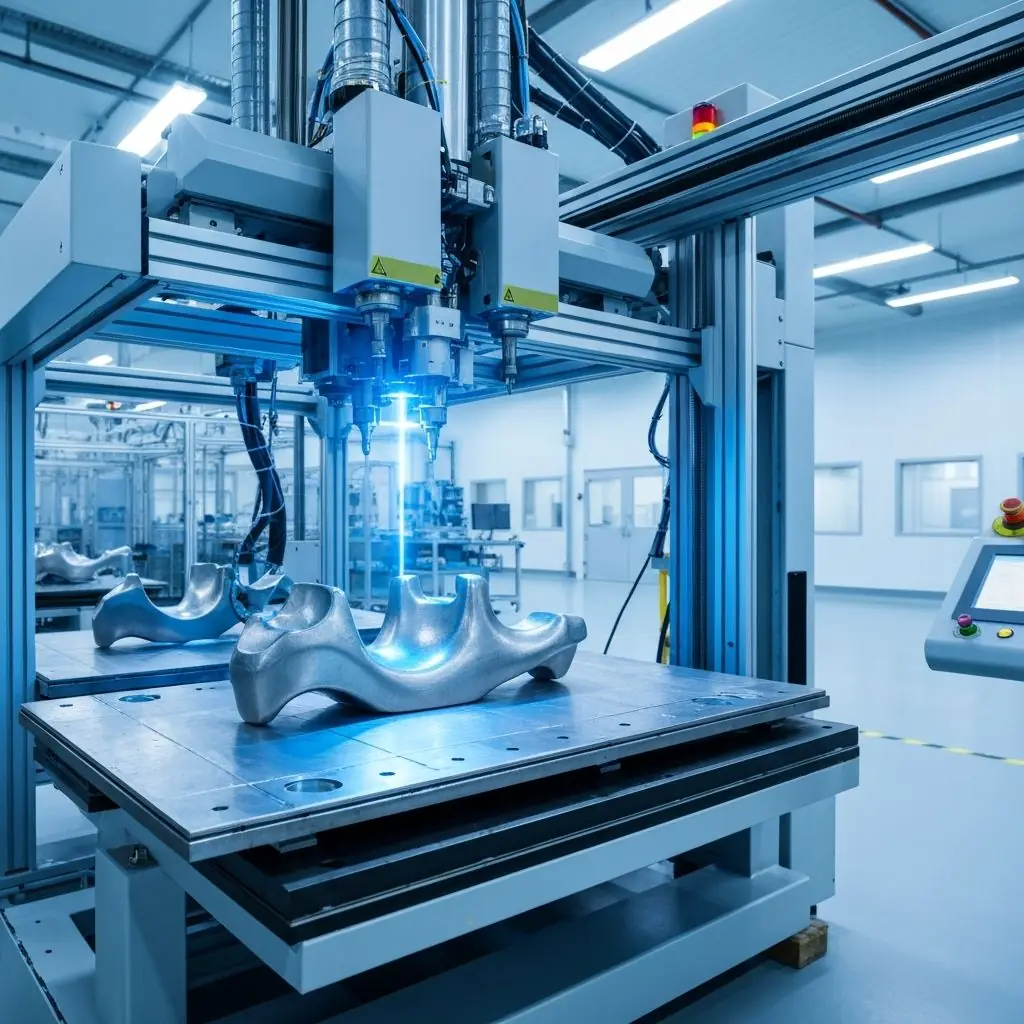
What Is the Practical Difference?
Both conventional porous-coated and 3D-printed porous titanium acetabular cups can be used to achieve cementless biological fixation.
The main difference is how the porous surface or structure is manufactured.
Conventional systems generally begin with a solid implant body and add or create a porous or roughened surface. Additive manufacturing can build the implant body and porous architecture as an integrated structure, allowing geometries and interconnected pore networks that may be difficult to produce with some conventional processes.
But that manufacturing distinction does not determine the clinical result on its own.
3D printing describes how an implant is manufactured. It does not, by itself, describe the clinical outcome.
For either technology, the clinically important questions remain the same:
Can the implant achieve reliable initial fixation? Is appropriate host bone available? Does the design match the reconstruction problem? And what evidence supports the specific implant?
Initial Stability Comes Before Bone Ingrowth
A porous structure may be designed to support bone ingrowth, but biological fixation develops only after the implant has achieved adequate mechanical stability.
Initial acetabular fixation may depend on:
-
implant geometry and press-fit;
-
acetabular preparation;
-
rim engagement;
-
host-bone quality and contact;
-
supplemental screw fixation when required.
This becomes especially important in revision surgery, where supportive bone may be incomplete or unevenly distributed.
Biological fixation cannot rescue an implant that is inadequately stable at implantation.
The word porous is therefore not enough to describe performance.
Pore size, total porosity, interconnectivity, porous depth, surface roughness and overall mechanical behavior may all differ between implants.
A better question is:
How does this specific porous architecture work within the complete fixation strategy?
Where Can 3D Printing Make a Difference?
Additive manufacturing may become more clinically relevant as the reconstruction becomes more complex.
Its design freedom can be useful when the implant needs to accommodate:
-
compromised acetabular bone stock;
-
irregular defect geometry;
-
reduced host-bone contact;
-
revision reconstruction;
-
additional fixation options;
-
more complex reconstructive geometries.
That does not mean every primary total hip arthroplasty requires a 3D-printed cup.
For many patients, a well-established conventional porous-coated cementless system may already provide an appropriate solution.
The distinction is especially important when comparing primary and revision THA.
| Clinical Question | Conventional Porous-Coated Cup | 3D-Printed Porous Titanium Cup |
|---|---|---|
| Initial fixation | Depends on geometry, preparation and host bone | Depends on the same fundamental factors |
| Biological fixation | May support ongrowth or ingrowth depending on design | Interconnected architecture may be designed to support ingrowth |
| Routine primary THA | Established option in many systems | May also be appropriate depending on product and indication |
| Complex bone loss | Depends on available system and fixation options | Additive design may provide additional reconstruction options |
| Evidence required | Product-specific | Product-specific |
The most useful principle is:
The technology should follow the reconstruction problem, not the other way around.
What Does Product-Specific Clinical Evidence Show?
General research on porous titanium can explain biological principles, but it cannot automatically prove the performance of a particular cup.
For AK Medical’s 3D ACT™ acetabular cup, product-specific clinical studies are available.
A 2024 prospective consecutive study evaluated 236 primary THA patients using the 3D ACT™ cup, with an average follow-up of 42.2 months. Harris Hip Score improved from 43.7 to 85.6, WOMAC decreased from 59.2 to 13.1, 92.3% of patients reported being satisfied or very satisfied, and cup survival at the latest follow-up was 100% [1]. The authors emphasized that longer-term and multicenter randomized evidence would still be needed.
An earlier 2020 study followed 92 patients (108 hips) for an average of 48.2 months. HHS improved from 45.2 to 95.8, WOMAC decreased from 54.4 to 11.2, satisfaction was 91.3%, and no acetabular cup failure was reported during follow-up [2]. The study was retrospective and the authors likewise called for longer-term confirmation.
These studies are useful because they evaluate an identifiable product rather than porous titanium as a generic technology.
They should still be interpreted at the correct evidence level:
favorable short- to mid-term product-specific results are not the same as proof of long-term superiority over conventional porous-coated cups.
That distinction matters.
What Should Surgeons and Hospitals Actually Compare?
A useful product evaluation goes beyond asking whether a cup is 3D printed.
For surgeons, the clinically relevant comparison includes:
-
fixation philosophy;
-
cup geometry;
-
host-bone requirements;
-
liner and screw options;
-
revision strategy;
-
Surgical Technique;
-
product-specific clinical evidence.
For hospital and procurement teams, the comparison should also include:
-
instrumentation;
-
inventory requirements;
-
regulatory status;
-
product compatibility;
-
supply reliability;
-
technical support.
Surface technology alone cannot compensate for weaknesses elsewhere in the clinical or operational pathway.
Instead of asking:
“Which cup is more advanced?”
the better questions are:
Which cup fits this reconstruction?
and
What evidence supports the exact product we are considering?
Where AK Medical Fits
AK Medical’s current acetabular portfolio includes both 3D trabecular-metal and conventional porous-coated cup systems, as well as cemented, dual-mobility and revision reconstruction options.
For example, the current catalogue includes the AK-AC-II-TTM series with a 3D trabecular titanium structure and the AK-AC-II-TP acetabular cup with a titanium plasma-sprayed porous coating. The catalogue also includes revision cups, augments, dual-mobility systems and other acetabular reconstruction components. AK Medical
This makes the clinically relevant comparison more useful than simply asking:
“3D printed or conventional?”
A stronger evaluation connects:
implant architecture → initial fixation → available host bone → reconstruction requirement → clinical evidence.
That is the level at which a product should be selected.
Explore AK Medical Acetabular Reconstruction Options
Surgeons and hospital teams can review AK Medical’s current acetabular portfolio—including 3D porous, conventional porous-coated, dual-mobility and revision options—through the existing product catalogue. AK Medical
Explore AK Medical Hip & Acetabular Products
For a specific primary or revision acetabular case, product enquiry, regulatory information or technical discussion:
Discuss an Acetabular Reconstruction Case with the AK Medical International Team
AK Medical’s official international contact page currently lists sales@ak-medical.net and WhatsApp +86 150 0110 2275 for overseas enquiries. AK Medical
Frequently Asked Questions
Are 3D-printed acetabular cups automatically better than conventional porous-coated cups?
No. Manufacturing method alone does not establish clinical superiority. Implant design, initial fixation, host bone, surgical technique and product-specific evidence all matter.
Does higher porosity mean better bone ingrowth?
Not automatically. Porosity is one design variable among several. Interconnectivity, implant stability, host-bone contact and overall mechanical behavior also matter.
When may a 3D-printed cup be particularly relevant?
It may be useful when the specific design provides additional fixation or reconstruction options in compromised bone, revision defects or anatomically complex situations.
Does a 3D-printed porous structure replace the need for good initial fixation?
No. Adequate mechanical stability remains fundamental before biological fixation can develop.
Are conventional porous-coated cups outdated?
No. Established porous-coated cementless systems remain appropriate reconstruction options in many primary and revision situations.
What evidence should surgeons ask for?
Product-specific mechanical and clinical evidence, including the exact implant studied, patient population, indication, follow-up and study limitations.
What should hospitals compare beyond implant price?
Instrumentation, liner and screw options, revision compatibility, regulatory status, inventory, supply reliability and technical support should also be considered.
Professional Notice
This article is intended for professional education, clinical technology evaluation and hospital procurement discussion. It does not constitute patient-specific medical advice.
Indications, contraindications, warnings, specifications, regulatory status and product availability may vary by product and market.
Treatment and implant selection should be determined by appropriately qualified clinicians using the applicable Instructions for Use, Surgical Technique, patient-specific clinical information and local regulatory requirements.
Published studies should be interpreted according to their design, population, follow-up duration and limitations. Product-specific short- or mid-term results should not be generalized into unsupported claims of long-term superiority.
References
- Chen et al. A prospective and consecutive study assessing short-term clinical and radiographic outcomes of Chinese domestically manufactured 3D printing trabecular titanium acetabular cup for primary total hip arthroplasty: evaluation of 236 cases. Frontiers in Surgery, 2024. doi:10.3389/fsurg.2024.1279194 · PMC11004300
- Geng et al. A new 3D printing porous trabecular titanium metal acetabular cup for primary total hip arthroplasty: a minimum 2-year follow-up of 92 consecutive patients. Journal of Orthopaedic Surgery and Research, 2020. doi:10.1186/s13018-020-01913-1 · PMC7487482
Related AK Medical products